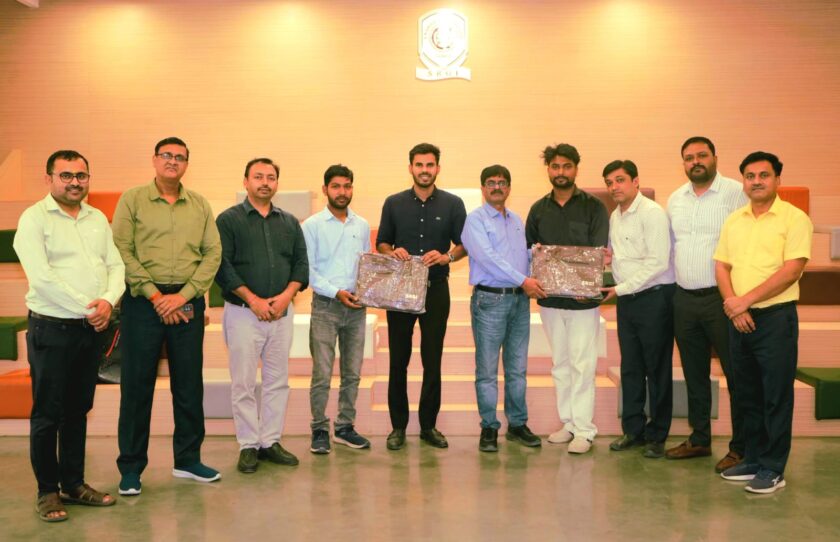
Lucknow: A delegation of senior officers from the National Defence College, under the National Security and Strategic Study programme of the Ministry of Defence, called on Uttar Pradesh Chief Minister Yogi Adityanath in Lucknow and held an interaction on governance, security, and development initiatives in the state.
The delegation included senior officers from the Indian Armed Forces, representatives of foreign militaries, and officials from the Government of India civil services currently undergoing training under the strategic studies programme.
Addressing the delegation, the Chief Minister said that trust and technology have emerged as the two major pillars driving the transformation of Uttar Pradesh. He noted that the state’s economy has grown nearly threefold over the past nine years and that Uttar Pradesh now possesses the largest highway and expressway network in the country, accounting for nearly 55 percent of India’s expressways.
Adityanath stated that before 2017, law and order posed a major challenge in the state. However, the government established the rule of law, effectively curbing illegal activities and disorder. Improved security conditions, he said, have accelerated investment and development across the state.
Highlighting strategic infrastructure, the Chief Minister informed the delegation about the rapid development of the Uttar Pradesh Defence Industrial Corridor, which is emerging as a major hub for defence manufacturing. He said a BrahMos missile production unit has been established in Lucknow and will function as an anchor unit, creating opportunities for numerous ancillary industries. Significant investments have also been received in the Kanpur node, while a production facility is operational in Hardoi. The delegation was invited to visit the defence corridor to gain firsthand insight into the project.
The Chief Minister also spoke about major infrastructure projects underway in the state, including the Noida International Airport, which is set to become the country’s largest international airport, and the nearly completed Ganga Expressway.
To strengthen modern policing, he said cyber forensic laboratories have been established in every division of the state, while each district has been equipped with forensic mobile vans and 75 cyber police stations.

Adityanath further highlighted the state’s progress in welfare delivery through digital governance. Through the Direct Benefit Transfer (DBT) system, benefits from government schemes are transferred directly into beneficiaries’ bank accounts. Around 80,000 fair price shops across the state now use e-POS machines to ensure transparent ration distribution.
He added that more than one crore destitute women, elderly citizens, and persons with disabilities receive an annual pension of ₹12,000 directly in their accounts. Under the Pradhan Mantri Awas Yojana, over 6.2 million houses have been provided to poor families in Uttar Pradesh, and recently 90,000 additional beneficiaries were added to the scheme.
During the interaction, officers asked why many well-designed policies in India often face challenges in implementation. Responding to this, the Chief Minister said that regular monitoring, field visits, and clear accountability are essential to ensure effective execution of policies.
The delegation also asked about his experiences during visits to Japan and Singapore. Adityanath said Japan’s civic sense, cleanliness, and discipline are exemplary, noting that the country has extensively adopted green energy, advanced mobility systems, and cutting-edge technologies. He added that Japanese industries have expressed strong interest in investing in Uttar Pradesh and that several proposals are expected to materialise soon.
The delegation was led by Air Marshal Manish Kumar Gupta, Commandant of the National Defence College. It included senior officers such as Brigadier Sameer Mehrotra, Brigadier Vipul Singh Rajput, Commodore Sharad Sinsunwal, Brigadier Bharat Bhushan, Brigadier Surya Veer Singh Rajvi, and officers from the armed forces of Sri Lanka, Mongolia, Maldives, Armenia, and Brazil, along with senior officials of the Government of India.